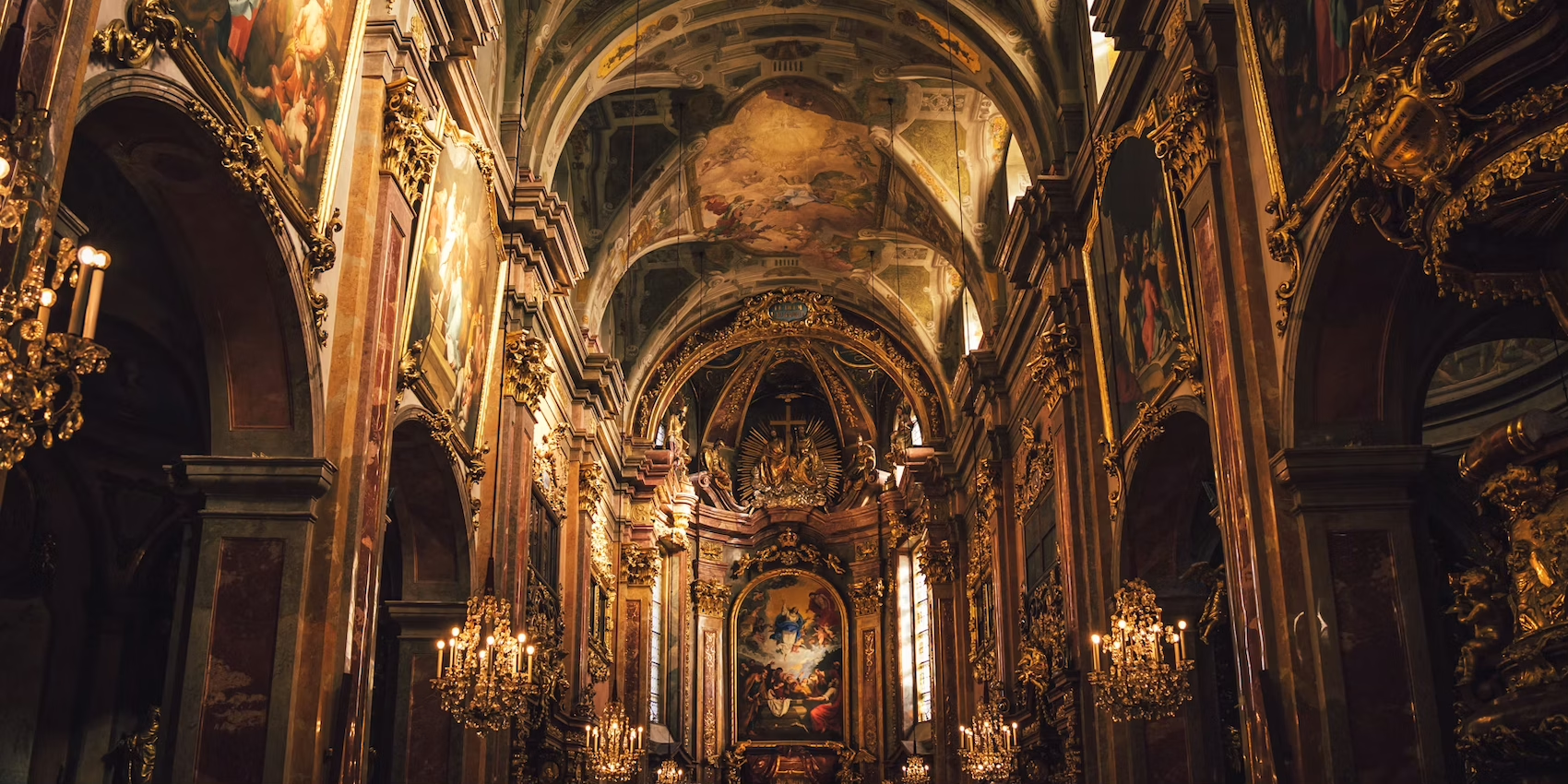
In a recent post for the Magis Blog, Magis Executive Director John Coffey wrote about 5 critical gaps in modern religious education. Among these, number 4 was “The Absence of Beauty and the Transcendent.” According to Coffey, the truths of the church “stick” more easily when they are accompanied by beauty—their fellow Transcendental. Together the 3 Transcendentals, Truth, Beauty and Goodness, are intrinsically interconnected at the deepest level. They are best received when they are encountered simultaneously, complementing each other and “fleshing each other out.”
The Neglect of Beauty
In his article, Coffey specifically addresses gaps in the education of catechumens. But similar gaps appear many other places, as well! In all kinds of spaces—including parochial schools, Christian/Catholic universities, and parish-based faith formation programs—beauty and the transcendent are often neglected. This is true for many reasons.
First, when practical needs assert themselves (i.e., the need for clothing and shelter), beautiful objects and practices can seem frivolous. Second, wide divergences in taste and aesthetic education can make it hard for groups of people to appreciate and enjoy the same things -at least at first. Third, recent trends in cultural analysis have challenged traditional ways of assessing aesthetic value and have generated distrust of once celebrated “classics.”
Confusion About Beauty
All these conditions have resulted in cultural confusion and polarization. For example, some religious people believe these changes necessitate a total return to much earlier ways of experiencing beauty, bypassing all modern developments. Other religious people strongly resist pronouncements of aesthetic value beyond personal taste and challenge any effort to impose “top-down” standards as corrupt. A few religious people, meanwhile, still think the scrubbed-down, efficient, minimalist style of the mid-twentieth-century is the most universal way forward—partly because it resists cultural specificity. Amidst these debates, ordinary people are deprived of the beautiful stimuli that could help heal their souls and bring them into alignment with the True and Good.
Reintroducing Beauty
So. . . how can we reintroduce beauty and transcendence in a way that speaks effectively to everyone?
At its most basic, the reintroduction of beauty must take place at the level of silent exposure. Lesson plans illustrated by classic artworks, beautiful pictures hanging on meeting room walls, and beautiful sanctuary ornamentation can “seep in” to one’s consciousness, acting as “background music” for practices and ideas. Through silent exposure, comfort builds and cultural literacy develops, almost without effort. Even if the artworks in these settings are never consciously analyzed, they form worshippers in deep ways.
Defining Beauty
And when it comes to this silent witness of beauty, “classic” works are indeed key. I believe that today, when so many of us have lost touch with our roots and have declined in cultural literacy, the visual “background music” of our sacred spaces should be time-tested, perennially admired, and theologically vetted. (This is perhaps the very definition of “classic”!) Such things will help us regain contact with our cultural roots. But the “classics” we choose (or choose to emulate) should not be too complicated or require a highly-developed understanding of aesthetic techniques. Nor should they reinterpret, deconstruct, or challenge cultural baselines—because for many of us, there are no longer cultural baselines to challenge! The “classics” that form a background to our spiritual lives should be as simple, accessible, and universal as possible without sacrificing true beauty, theological meaning, and time-tested belovedness (the latter bearing witness, as Chesterton says, to the “democracy of the dead”).
As we begin to live with these “classics,” we also (eventually) need to become reacquainted with the concrete principles of beauty. We need to remind ourselves that true beauty is not merely “in the eye of the beholder,” nor is it merely a cultural construct that reflects the ideology of whoever happens to be in power. Instead, beauty has identifiable features like (in the words of Thomas Aquinas) harmony, integrity, and luminosity. (See my past blog post.) As professional artists know, there are also rules of balance, proportion, and color combination that produce reliably beautiful results. Finally, there are mathematical concepts, such as the golden ratio, fractal formations, and pattern repetitions that both correlate to our experience of beauty and reveal the order of God’s creation. Knowledge of all these principles can assure us that beauty is real, universal, and complementary to other transcendentals like the Good and the True.
Finally, we need to be intentional about finding beauty in many different places. If we look only toward a narrow slice of traditional culture from one region of the world, we may alienate some worshippers, and we also deprive ourselves of the full complement of graced cultural products illuminating our shared home. Once we have gained familiarity with a classic aesthetic “vocabulary” of images, and once we have internalized philosophical and mathematical principles of beauty, we will be poised to recognize beauty in unexpected places. Both West African visual culture and Chinese visual culture share aesthetic principles similar to those articulated by Aquinas, for example. Indeed, artists’ tendencies to rapidly adopt aesthetic techniques from other cultures are a testament to the underlying similarities they all share. By this means, we can expand our understanding of beauty while building on a firm foundation.
The Importance of Beauty
“Flash,” “sexiness,” “romance,” “nostalgia,” and “luxury” are not the same things as beauty. Yet in our oversaturated, commercialized world, these things “sell.” And because of their dominance, they begin to confuse us about what is most worthwhile.
Beauty is a sign of the order inherent in God’s creation, including patterns and harmonies of healthy growth. It points toward the transcendent through its congruency to the deep things in God: his “eternal power and divine nature,” in the words of St. Paul. It’s time for churches everywhere to think carefully about the aesthetic environments they are creating and the implicit (or explicit!) messages they are sending through their aesthetic choices. When we regain a taste for true beauty, we will begin to wake up, rediscovering the majesty of God. As Psalm 34 declares, “Taste and see that the Lord is good!”