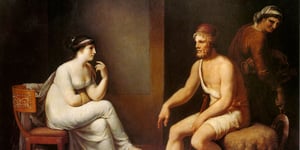
Zeus’s brother Poseidon might be able to shake the solid earth into city-destroying quakes and whip oceans in waves higher than hills; Hephaestus might make mountains burst with fire and flame; Zeus might fill the sky with thunder-booming clouds and scorch the world with cracks of lightning, but such displays were less than the whirling of gnats when set against those terrible forces of Time, Fate, Necessity, Justice, and Retribution. Before these impeccable executors of the deep will of the cosmos, all Titans, gods, men, women, and worlds were as fluff and chaff in the wind.
—Odyssey: The Greek Myths Reimagined by Stephen Fry
When Stephen Fry sat down to retell The Odyssey, the fourth and final volume of his Greek Myths series, he made a choice that turns out to be more theological than literary. Before Odysseus ever raises a sail, Fry pauses to tell us what actually rules the universe his hero is about to cross. It isn't Zeus. Thunder and lightning, Fry says, are almost nothing next to the forces that truly govern mortal life: time, fate, necessity, justice, and retribution. He adds that these are forces that cannot be prayed to or placated.
Five ruling powers. If that number sounds familiar to readers of this blog, it should. Fr. Robert Spitzer has spent decades arguing that human beings are wired with an awareness of five transcendentals: truth, love, justice/goodness, beauty, and home. We recognize the imperfect version of each one because, somehow, we already carry a sense of what the perfect version would be.
Set Fry's five forces beside Spitzer's five transcendentals and something interesting happens. They don't line up neatly. And the gap between them says as much about the difference between the ancient pagan imagination and the Christian one as any theology textbook could tell you.
What Are the Five Transcendentals?
The five transcendentals are truth, love, justice/goodness, beauty, and home, five dimensions of reality that Fr. Spitzer identifies as things every person desires in a perfect form, even though we only ever encounter imperfect versions of them. We know a friendship is imperfect because some part of us already recognizes what perfect love would look like. We call a verdict unjust because we're measuring it against a standard of justice nobody around us has ever fully lived out. Spitzer's full argument traces this awareness back to its only plausible source: a perfect Being who is truth, love, justice, beauty, and home all at once.
What Are Stephen Fry's Five Forces in the Odyssey?
Fry's five forces are time, fate, necessity, justice, and retribution, the impersonal powers that govern the ancient Greek cosmos and that even the gods themselves cannot escape. This is the oldest layer of the Greek imagination, older than Zeus's lightning bolts. Necessity, in particular, was understood by early Greek thinkers as a power that bound the gods the way gravity binds a stone. Nothing, divine or mortal, gets to argue with it.
Notice the shape of that list. Justice is there. Retribution, its harder cousin, is there too. Time and fate hem in every choice a character makes. But love isn't named as one of the forces that rule the universe. Neither is beauty. They exist in Fry's Odyssey, richly, but they aren't cosmic law. They're something that happens to people inside a universe that doesn't especially care whether they happen or not.
Where Justice Meets Justice
Justice is the one place the two lists touch directly, and Homer gives us no better illustration of it than the poem's ending. When Odysseus finally reaches Ithaca, he doesn't walk through the front door. He returns in disguise, watches, and waits, because the suitors who have spent years devouring his household and pressuring his wife have violated something the ancient Greeks considered sacred: xenia, the law of hospitality between guest and host. Their punishment in book twenty-two isn't framed as an act of anger. It's framed as accounts finally being settled, necessity catching up with men who assumed it never would.
Athena
looked straight at him, clear-eyed. She said, ‘I will
be with you, truly. Know I stand beside you
as we begin our work. I do believe
the suitors who devour your livelihood
will spatter your broad floors with blood and brains.
But now I will disguise you, so no human
will recognize you. I will shrivel up
the fine skin of your supple arms and legs,
ruin your hair, and dress you up in rags,
so everyone will shudder, seeing you.
And I will cloud your eyes, to make you seem
ugly to all suitors, and your wife
and to the son you left at home.’
—The Odyssey (Book 13) by Homer (translated by Emily Wilson)
That's justice as Fry describes it: retributive, cosmic, unbending. Scripture holds justice to a slightly different standard, one that refuses to let it stand alone. The prophet Micah puts both halves in the same breath: "Only this: to do what is right, to show mercy, and to walk humbly with your God" (Micah 6:8). Homer's justice settles a debt. Micah's justice is inseparable from mercy. That single word, mercy, is doing work that no force on Fry's list was ever built to do.
“The Lord has told you, O man, what is good.
And what does the Lord require of you?
Only this: to do what is right, to show mercy,
and to walk humbly with your God.”
—Micah 6:8
Fate, Necessity, and the Hunger for Truth
If fate and necessity are the forces bearing down on Odysseus from outside, his response to them is remarkably active. He wants to know what's coming. In book eleven, he sails to the edge of the underworld specifically to consult the blind prophet Tiresias, because a fate you can't see is unbearable in a way a fate you understand is not. He needs the truth of what's ahead, not to escape it, but to meet it with his eyes open.
“. . . Then you will go home
and offer holy hectacombs to all
the deathless gods who live in heaven, each
in order. Gentle death will come to you,
far from sea, of comfortable old age,
your people flourishing. So it will be.”
—The Odyssey (Book 11) by Homer (translated by Emily Wilson)
That's Spitzer's transcendental desire for truth, dramatized almost perfectly. We don't just want information. We want to see past the horizon of what's currently visible to us, toward a truth that would finally make sense of everything. Odysseus rows to the underworld to do exactly that. Most of us just keep asking questions, which Spitzer would say is the same instinct wearing more ordinary clothes.
Time, Home, and the Choice Odysseus Makes
Of all Fry's five forces, time is the strangest, because in book five, Odysseus is offered a way out of it entirely. Calypso holds him on her island for seven years and offers him immortality if he'll stay. No aging. No death. No end.
“So Odysseus, with tact,
said, ‘Do not be enraged at me, great goddess.
You are quite right. I know my modest wife
Penelope could never match your beauty.
She is human; you are deathless, ageless.
But even so, I want to go back home,
and every day I hope that will come.
If some god strikes me on the wine-dark sea,
I will endure it. By now I am used
to suffering—I have gone through so much,
at sea and in the war. Let this come too.’”
—The Odyssey (Book 5) by Homer (translated by Emily Wilson)
He says no. He chooses a mortal life, a graying wife, a son who has grown up without him, and a rocky island kingdom that will never be Olympus, over an eternity spent somewhere that isn't home. It's one of the more astonishing moments in ancient literature, and it only makes sense in light of Spitzer's fifth transcendental. We don't actually want endless time in a place we don't belong. We want home, even a difficult one, over forever spent as a guest. Odysseus understood something that later Christian writers would say explicitly: that the ache for home is not a wish for more time, but a wish for a particular kind of belonging that time alone can never supply.
In the trailer for Christopher Nolan's The Odyssey, Odysseus (played by Matt Damon) says, "I remember a wife. A son. Home."
What Fry's Cosmos Leaves Out
Here is the real payoff of setting these two lists side by side. Fry's universe runs on time, fate, necessity, justice, and retribution, and every one of those forces is, in some sense, cold. None of them loves anybody back.
Yet love is the current running underneath nearly every scene in The Odyssey that still moves modern readers. Argos, the old dog nobody else recognizes, lifts his head for Odysseus after twenty years and dies having seen his master one last time. Eurycleia, washing a stranger's feet, finds the old scar on his leg and knows him instantly. Penelope tests the man claiming to be her husband by asking a servant to move their marriage bed, a bed Odysseus built around a living olive tree and that cannot be moved without destroying it, and only the real Odysseus reacts with the outrage of a man watching his own labor be casually undone. None of that is cosmic law. It's love, showing up in the smallest, most physical details, and Fry's list of governing forces has no category for it at all.
Scripture does.
"Whoever does not love
does not know God,
because God is love.”
—1 John 4:8
That is a claim the Homeric cosmos, for all its grandeur, simply cannot make about itself. Fate and necessity can organize a universe. Only love can be its source.
Why the Five Transcendentals Still Matter
Put together, Fry's five forces and Spitzer's five transcendentals tell a strangely complementary story. The ancient world already sensed that something beyond Zeus, beyond the gods themselves, was structuring reality: time pressing forward, fate laying down a path, justice demanding an accounting. Homer's audience knew, the way we all know, that the world runs on more than appetite and lightning bolts.
What that world lacked was a name for the possibility that the power behind justice, truth, beauty, and home might also, at its center, be love. That's the claim Christianity makes and the ancient Greek cosmos never quite reaches. Odysseus rows toward truth, refuses eternity for the sake of home, and finally receives justice from a universe that seems to owe it to him. He never once gets to hear that the whole structure he's straining against might actually love him. Readers of Spitzer's work do.
If this comparison has you thinking more deeply about where our deepest longings come from, Fr. Spitzer's Happiness, Suffering & Transcendence Quartet picks up this thread, tracing truth, love, justice, beauty, and home back to the God who is their source rather than their rival.
In his retelling of Homer's epic, Stephen Fry names time, fate, necessity, justice, and retribution as the forces that truly govern the ancient Greek universe, calling them powers that cannot be prayed to or placated, more absolute than even the gods.