I dislike Thanksgiving.
For one thing, my grandmother used to make me sit at the kids’ table, drink skim milk, and eat beets (at least I had my brother, who would race Matchbox cars with me under the table).
But beyond that annual blemish, I’ve always been terrible at giving thanks. As a typical egocentric kid, I took life's blessings—family, health, and general comfort—for granted because I assumed they would always be there. What was the point of giving thanks?
Nowadays, I struggle with it because a single day seems woefully inadequate for the abundance of blessings that God has given me.
Why Is the Eucharist Called Thanksgiving?
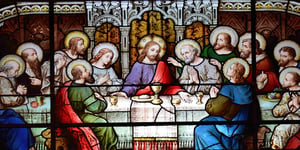
The word Eucharist comes from the Greek eucharistia, meaning thanksgiving. Catholics call the Mass a thanksgiving because it both remembers God's gifts and returns them: the bread and wine offered at the altar are first received from God, then given back. Gratitude isn't an add-on to the Mass; it's the structure of it.
Fortunately, gratitude is not sequestered to a single day for Catholics.
The language of thanksgiving even appears throughout our liturgy. During the Eucharistic Prayer, the priest proclaims that it is “truly right and just, our duty and our salvation, always and everywhere to give You thanks.” Similarly, we traditionally begin prayer with praise and thanksgiving before presenting petitions.
For years, I assumed the Catholic emphasis on thanksgiving was simply a method of acknowledging God's blessings. Over time, I’ve realized that the Church's emphasis on gratitude rests on a particular understanding of the human person. Catholicism views life as a gift that is received rather than earned. We’re not worthy of God’s gifts. None of us have even approached a perfect life to earn them. Yet we receive them.
The Catholic understanding of thanksgiving acknowledges that, before we offer love, someone first loves us; before we contribute to the world, countless others have contributed to our formation; and, before we can give anything, we must first receive.
As I've grown older and become more aware of how much of my life has been given (rather than earned), I've become fascinated by how often this Catholic intuition appears in science, where I spend a great deal of my time.
Why Are Humans Born Dependent on Others?
Human newborns are born with brains less than 30% of their adult size, meaning most brain development happens after birth. In the first years of life, more than one million new neural connections may be formed in a second. But this growth is not a simple outcome of genetics.
The quality of care a child receives facilitates synaptogenesis (the development of new connections between nerve cells), and decides which connections last. When that care is missing, development suffers. In a randomized trial of Romanian orphans, children who remained in the institution scored far below those moved into foster care.
Concurrently, humans have evolved as cooperative breeders; we rely on fathers, grandparents, and others to help raise children. In fact, some studies suggest that our ancestors could not have produced large-brained, slow-maturing infants without reliance on both family and other community members to help care for and nurture offspring.
The implication of these findings is clear: everyone enters the world largely dependent on other people. Long before we contribute anything to society, a myriad of others provide what we cannot provide for ourselves. Parents, grandparents, teachers, coaches, mentors, and friends participate in forming the person we eventually become. Even the most basic aspects of our identity emerge within a community of relationships.
Why Do We Inherit More Than We Create?
Consider something as ordinary as language. None of us invented the words we speak. We learned them because someone spoke to us before we understood their meaning. The same is true of our values, traditions, habits, beliefs, and much of what we regard as uniquely our own. We inherit far more than we create.
Adulthood has a way of obscuring this reality. We rightly value discipline, responsibility, and hard work, but those virtues can cause us to overestimate our own self-sufficiency. Every achievement rests upon foundations that were laid by others. Every success depends, at least in part, upon gifts that preceded our efforts.
The older I become, the more difficult it is to ignore this truth. My faith, my education, my opportunities, and many of the relationships that have shaped my life all began as gifts. I certainly played a role in developing them, but I did not originate them.
What Does Scripture Say About Receiving Before Giving?
This theme appears repeatedly throughout salvation history. Before Adam and Eve could respond to God, they received life itself. Before Abraham demonstrated his faith, he received God's promise. Even the New Testament describes our relationship with God in the same terms: "We love because He first loved us" (1 Jn 4:19). The biblical story consistently portrays human beings as recipients before they become responders, a reality that echoes the biological truth that we receive long before we are capable of giving.
That realization doesn’t come naturally. We have a nasty and persistent tendency to focus on what is missing, while readily recalling disappointments, frustrations, and losses far more easily than daily blessings. Psychologists call this the negativity bias. One landmark review found it so consistently across relationships, feedback, memory, and first impressions that the authors concluded "bad is stronger than good," as a general principle across a broad range of psychological phenomena.
The good news is that our biblical and liturgical mandates for thanksgiving serve as a corrective to this tendency. In randomized trials, people who regularly listed what they were grateful for reported better moods and more positive views of their lives than those who listed hassles, while a larger analysis of 25 such trials involving over 6,700 subjects confirmed a boost to well-being.
This is one of many reasons why the Catholic Church returns again and again to the Eucharist. At every Mass, we are reminded that our lives are sustained by gifts that we neither create nor earn. And the Mass’s most central piece? A reverent celebration of thanksgiving.
When I think about Thanksgiving nowadays, I find myself returning to a simple observation: before I accomplished anything, I had already received almost everything necessary to become who I am. My grandmother who fed me beets also taught me, encouraged me, challenged me, forgave me, prayed for me, and loved me long before I had the opportunity to return those gifts.
Both biology and Scripture proclaim this same story. The former describes it through relationships, development, and human flourishing; the latter describes it through grace, gift, and gratitude.
We receive before we give.
Frequently Asked Questions
Common questions about thanksgiving, the Eucharist, and what the Catholic Church and science say about gratutide.
Why is the Eucharist called thanksgiving?
The word Eucharist comes from the Greek eucharistia, meaning thanksgiving. At Mass, Catholics remember God’s gifts and offer them back: the bread and wine are first received from God, then returned to him at the altar.
What does eucharistia mean?
Eucharistia is Greek for “thanksgiving.” It is the root of the word Eucharist, the Catholic name for the sacrament of Christ’s Body and Blood and for the Mass itself.
Why is gratitude important in the Catholic faith?
Catholicism teaches that life is a gift received, not earned. Gratitude acknowledges that God loved us first and that others shaped us long before we could give anything back.
What does the Bible say about receiving before giving?
Scripture repeatedly shows people receiving from God before they respond. Adam and Eve received life, Abraham received God’s promise, and 1 John 4:19 says, “We love because He first loved us.”
What is the negativity bias?
The negativity bias is the human tendency to notice and remember bad experiences more strongly than good ones. Researchers have found it across relationships, memory and first impressions. Practicing gratitude helps counter it.