There is a particular kind of silence that falls over a dinner table when a fourteen-year-old comes home from biology class and asks, point-blank, whether the story of Adam and Eve is something the family actually believes or something they simply say. Most parents know that silence. It isn't doubt, exactly—it's the sound of not having an answer ready, and sensing that the moment matters more than it looks like it does.
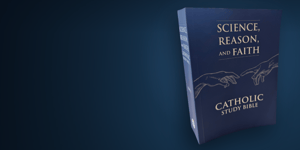
Father Robert Spitzer, president of the Magis Center for Reason and Faith, has spent decades watching what happens when that question goes unanswered. Young people rarely announce that they've lost their faith. More often, they simply reclassify the Bible instead, filing it away as a beautiful old book rather than a true one, a moral fable rather than a record of what God actually did in history. Once that reclassification happens, everything built on top of it tends to loosen. Spitzer's response, the product of years spent working across theology, cosmology, and biblical history, is the Science, Reason, and Faith Catholic Study Bible, published by OSV, now in stock and shipping to homes, parishes, and classrooms.
By his account, it is the only Catholic study Bible of its kind: one that meets hard questions about science and history directly in the margins, exactly where the question would naturally arise, rather than tucking them into a chapter a curious reader would have to go looking for. If you're weighing which Catholic study Bible actually earns a place on a nightstand or a classroom shelf, this is the case for it.
Why So Many Young People Drift, Quietly
The drift rarely starts as rebellion. It starts as arithmetic. A student learns that the universe is roughly 13.8 billion years old, that the Earth formed some 4.5 billion years ago, and that life appeared not long after, geologically speaking. Then she opens Genesis and finds six days and a genealogy that adds up to something closer to six thousand years. Nobody has explained to her that these two accounts were never competing for the same job, so she assumes one of them has to lose. That assumption, repeated across a thousand small moments, is what eventually convinces a bright, sincere young person that faith is something you set aside once you grow up. It's an entirely avoidable tragedy, and it's the one this book was written to prevent.
Can Genesis and the Big Bang Both Be True?
Pope Pius XII answered this question in 1943, in an encyclical called Divino Afflante Spiritu, though few people outside a seminary have ever heard of it. Scripture, he wrote, exists to communicate the truths necessary for salvation. Science exists to give an empirical, mathematical account of the physical universe. Ask either one to do the other's job and a contradiction appears that was never actually there. Keep the two domains distinct, and respectful of each other's territory, and the apparent conflict dissolves on its own. The Science, Reason, and Faith Catholic Study Bible spends its opening pages tracing exactly how that principle applies, chapter by chapter, to creation, the fall, the flood, and Babel.
A Church That Helped Build Modern Science
Part of what makes this Bible unusual is the space it gives to a fact most students never encounter: the Catholic Church did not merely tolerate science from a cautious distance. It helped build large parts of it. Gregor Mendel, the father of modern genetics, was an Augustinian abbot. Georges Lemaître, the Belgian priest who first worked out what we now call the Big Bang, published the theory in 1927 with a physics doctorate from MIT in hand. Nicholas Steno laid the groundwork for modern geology. Roger Bacon, a Franciscan friar, is widely credited with formulating the scientific method itself, and Nicolaus Copernicus, a cleric of the Church, rewrote an entire cosmology from the ground up. A tradition capable of producing that kind of intellectual output was never at war with reason—it has, for most of its history, been one of reason's more serious patrons.
Is There Real Historical Evidence for Jesus?
The New Testament introduction shifts the focus from cosmology to history, and it takes seriously the one question on which every other Christian claim ultimately rests: did any of this actually happen? Spitzer draws on what scholars call the third quest for the historical Jesus, particularly the eyewitness criteria developed by Richard Bauckham and extended by figures like N. T. Wright and John P. Meier. These aren't devotional arguments dressed up to look academic. They are the same historical methods scholars use to authenticate any piece of ancient testimony, applied here to the Gospel accounts of Jesus's teaching, his death, and his resurrection.
Much of this section turns on the Shroud of Turin, the fourteen-foot linen cloth bearing a three-dimensional, photographic-negative image of a crucified man. The book surveys decades of forensic and physical analysis: wounds that correspond, in precise anatomical detail, to the Gospel description of the scourging, the crown of thorns, and the spear wound between the ribs. Spitzer lays out the case, built by researchers across several decades, that the image has never been reproduced by any known pigment, scorch, or photographic technique, and he presents the explanation he finds most persuasive: a burst of radiation at the moment of resurrection, forceful enough to imprint the image, brief enough to leave the blood stains undisturbed. A reader doesn't have to arrive at the same conclusion to benefit from the exercise. What the shroud material offers young people is rarer than reassurance—it's something to go investigate for themselves.
More Than an Old Book of Stories
That same instinct—how the evidence and let it argue its own case—carries through the book's treatment of Eucharistic miracles studied in Buenos Aires, Tixtla, and Sokółka over the past three decades, and its account of the Marian apparitions at Guadalupe and Fátima, including the day in 1917 when tens of thousands of witnesses reported the sun moving in the sky. Spitzer doesn't ask readers to accept any of it on faith alone. He walks through the medical documentation and the historical record and lets it speak.
How This Catholic Study Bible's Margin Commentary Works
What sets the format apart from a conventional study Bible is where the answers live. Rather than isolating commentary in a separate essay, the Science, Reason, and Faith Catholic Study Bible places its explanations directly beside the verse that raises the question. Read the conquest narratives in Joshua, where Moses instructs the Israelites to spare no one in the conquered Canaanite territories, and the margin is there to draw the distinction, developed by Joseph Ratzinger, between a passage's inspired core and the cultural husk surrounding it. The enduring command was to resist the corrupting pull of Canaanite religion, not the violence a Bronze Age warrior culture used to enforce it. Read John 6, and the margin traces the grammar and the historical criteria that make it exceedingly difficult to read Christ's words on the Eucharist as merely symbolic. The commentary meets the question at the exact moment it occurs to a reader, which is precisely when an answer does the most good.
Why Every Catholic School Needs This Study Bible
None of this is really about winning an argument. It's about handing young people, and the adults raising them, something sturdier than a book they're told to trust and hope no one challenges. It's about giving them a Bible that has already sat with the hardest question in the room and hasn't flinched. A Bible that treats Genesis, the Gospels, and two thousand years of Church history as claims about what actually happened, worth the same scrutiny anyone would apply to any other historical record, and worth full confidence once that scrutiny is done.
That confidence is the entire point. A young person who understands why Genesis and cosmology were never in competition, who has seen the historical case for the resurrection laid out plainly, is far less likely to drift into the quiet unbelief that so often masquerades as growing up. She's more likely to become something far more useful to everyone around her: someone who can hold her faith and her intellect in the same hand, without setting either one down.
The Science, Reason, and Faith Catholic Study Bible is available now from OSV, from Amazon, and through the Magis Center Store, which also offers bulk discounts for schools. Alongside it, the Magis Center has released a companion app, Magis AI, free on the Apple App Store and Google Play, built to answer scripture and science questions on the spot. Between the two, a student headed off to college, or a teacher standing in front of a classroom full of hard questions, has something worth carrying: a faith that has already done its homework.
Frequently Asked Questions
Among current options, the Science, Reason, and Faith Catholic Study Bible stands out for placing its answers directly in the margins beside the verse in question, rather than in a separate section a reader has to seek out. Written by Fr. Robert Spitzer of the Magis Center, it addresses Genesis and cosmology, the historicity of Jesus, the Shroud of Turin, and Eucharistic and Marian miracles throughout its introductions and commentary.
Yes. The Church has never taught that Genesis is meant as a scientific account of the universe's age. Following the distinction Pope Pius XII drew in his 1943 encyclical Divino Afflante Spiritu, Scripture communicates truths necessary for salvation, while science describes the physical mechanics of the universe. Notably, a Catholic priest, Georges Lemaître, was the first to propose the Big Bang theory, publishing his work in 1927.
The Shroud of Turin is among the most extensively studied artifacts in existence. Researchers have documented a three-dimensional, photographic-negative image with anatomical detail matching the Gospel accounts of Christ's passion, an image that has not been reproduced by any known technique to date. The Science, Reason, and Faith Catholic Study Bible devotes substantial attention to this research in its New Testament introduction.
Scholars including Richard Bauckham, N. T. Wright, and John P. Meier have developed historical criteria for identifying eyewitness testimony within the Gospels, using methods drawn from ancient historiography more broadly. This body of scholarship, often called the third quest for the historical Jesus, is a central part of the study Bible's New Testament commentary.
Father Robert Spitzer, a Catholic priest and president of the Magis Center for Reason and Faith, wrote the study Bible's introductions and margin commentary.
The Bible is available now from the Magis Center Store (which offers a discount for schools ordering in bulk), OSV, and Amazon.
What is the best Catholic study Bible for questions about science and history?
Among current options, the Science, Reason, and Faith Catholic Study Bible stands out for placing its answers directly in the margins beside the verse in question, rather than in a separate section a reader has to seek out. Written by Fr. Robert Spitzer of the Magis Center, it addresses Genesis and cosmology, the historicity of Jesus, the Shroud of Turin, and Eucharistic and Marian miracles throughout its introductions and commentary.
Does the Catholic Church accept the Big Bang and an old universe?
Yes. The Church has never taught that Genesis is meant as a scientific account of the universe's age. Following the distinction Pope Pius XII drew in his 1943 encyclical Divino Afflante Spiritu, Scripture communicates truths necessary for salvation, while science describes the physical mechanics of the universe. Notably, a Catholic priest, Georges Lemaître, was the first to propose the Big Bang theory, publishing his work in 1927.
Is there scientific evidence for the Shroud of Turin?
The Shroud of Turin is among the most extensively studied artifacts in existence. Researchers have documented a three-dimensional, photographic-negative image with anatomical detail matching the Gospel accounts of Christ's passion, an image that has not been reproduced by any known technique to date. The Science, Reason, and Faith Catholic Study Bible devotes substantial attention to this research in its New Testament introduction.
What historical evidence exists for the life of Jesus?
Scholars including Richard Bauckham, N. T. Wright, and John P. Meier have developed historical criteria for identifying eyewitness testimony within the Gospels, using methods drawn from ancient historiography more broadly. This body of scholarship, often called the third quest for the historical Jesus, is a central part of the study Bible's New Testament commentary.
Who wrote the Science, Reason, and Faith Catholic Study Bible?
Father Robert Spitzer, a Catholic priest and president of the Magis Center for Reason and Faith, wrote the study Bible's introductions and margin commentary.
Where can I buy the Science, Reason, and Faith Catholic Study Bible?
The Bible is available now from the Magis Center Store (which offers a discount for schools ordering in bulk), OSV, and Amazon.