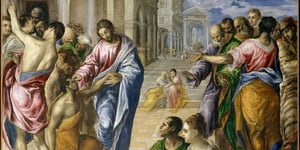
What is mercy, really? To answer that question, we must first understand what we mean by it. In a confused culture, clarity about mercy may be one of the most compassionate things we can offer.
What Is Mercy? A Word That Carries the World
To ask "what is mercy?" is to ask one of the oldest and most searching questions of the human heart. Before we can extend mercy, we must understand what we are extending. Words are not neutral. They carry history in their syllables, theology in their roots. And the word mercy is no exception.
The roots of the word run surprisingly deep. Consider the journey from language to language:
- English mercy descends from the Old French merci, meaning "reward" or "gift given freely."
- Old French merci came from the Latin merces, which originally referred to wages, payment, or the price of a thing.
- In the hands of the early Church, merces was transformed: it came to describe not what is earned, but what is given beyond earning—the kindness that exceeds what justice requires.
The Hebrew behind the Old Testament's language of mercy is richer still. The word chesed (often translated as mercy, loving-kindness, or steadfast love) carries overtones of covenant fidelity, tenderness between bound parties, and the generous overflow of loyalty. It is the love that stays when it would be easier to leave. Hosea captures it with disarming directness:
"For it is love that I desire, not sacrifice, and knowledge of God rather than burnt offerings."
—Hosea 6:6
The Greek eleos, used throughout the New Testament, echoes the idea of compassion arising from seeing need. It is relational. It moves. It acts. And the Latin misericordia, which the Vulgate so often renders mercy, is a compound of two words:
- Miser: wretched or miserable
- Cor: heart
Misericordia is, literally, a heart for the miserable. Mercy is not simply tolerance or restraint. It is the movement of a heart toward suffering.
Mercy is not simply tolerance or restraint. It is the movement of a heart toward suffering: love encountering misery and refusing to look away.
Understanding the word is not merely an academic exercise. It is formative. When we recover the full meaning of mercy—gift freely given, covenant faithfulness, a heart moved by the wretched—we realize that mercy is not weakness. It is not excusing evil or abandoning truth. It is something far greater: love acting in the place where pain lives.
Mercy in Scripture: From the Shepherd's Staff to the Mud on a Blind Man's Eyes
The scriptures do not merely define mercy. They perform it. Every page offers a fresh rendering of what it looks like for divine love to meet human suffering. In the Lenten readings this week, this drama reaches one of its most luminous expressions.
In the First Reading, Samuel is sent to anoint a new king (1 Samuel 16:1b, 6-7, 10-13a). He arrives at Jesse's household, ready to be impressed by the obvious candidates: the tall ones, the strong ones, the ones who look the part. But God redirects him:
"Not as man sees does God see, because man sees the appearance but the LORD looks into the heart."
—1 Samuel 16:7
This is mercy in its foundational form: the refusal to judge by surface. God sees David (the youngest, the overlooked, the one sent to tend the sheep while his brothers stood in the spotlight) and chooses him. Mercy here is not sentimental. It is piercing. It acts from truth rather than assumption.
The Responsorial Psalm deepens this image. Psalm 23 gives us the Shepherd who leads, restores, and accompanies us through the darkest valleys. Here mercy has a texture: attentive, patient, present.
"Even though I walk through the valley of the shadow of death, I fear no evil; for you are with me; your rod and your staff, they comfort me."
—Psalm 23:4
The Shepherd does not shout from a distance. He walks beside. And notice the progression of mercy in the Psalm: the Lord restores the soul, leads in right paths, prepares a table in the presence of enemies. Mercy is not passive. It is active, purposeful, and lavishly generous.
"You anoint my head with oil; my cup overflows. Surely goodness and mercy shall follow me all the days of my life, and I shall dwell in the house of the LORD forever."
—Psalm 23:5-6
In the Second Reading, Paul calls the Ephesians to live as children of light; mercy extended outward, not just received but embodied:
"For you were once darkness, but now you are light in the Lord. Live as children of light, for light produces every kind of goodness and righteousness and truth."
—Ephesians 5:8-9
To live as light is to illuminate what is hidden, to reveal what is true, to resist the comfortable darkness of pretending not to see. The mercy of God, received, becomes the light we are called to carry.
And then there is the Gospel of John (John 9:1-41): the healing of the man born blind. This passage is the icon of this week's reflection on mercy.
The disciples ask a question that reveals the ancient impulse to explain suffering before encountering it:
"Rabbi, who sinned, this man or his parents, that he was born blind?"
—John 9:2
Jesus refuses the premise entirely. He does not assign blame. He sees the man: not as a theological problem to be solved but as a person to be healed. He makes clay with his own hands and places it on the man's eyes. Sight is given not through a lecture, but through personal, tender, incarnate contact.
"As long as I am in the world, I am the light of the world."
—John 9:5
The mercy of Jesus in this passage has several features worth noting:
- It interrupts. Jesus does not wait to be asked. He sees, and he acts.
- It is physical. The healing involves touch, mud, water; embodied compassion that does not keep its distance.
- It provokes. The religious authorities are disturbed, not grateful. Mercy that truly heals often unsettles those invested in the existing order.
- It includes formation. After the healing, Jesus finds the man again and leads him to deeper faith. Mercy does not simply fix; it accompanies.
This is what mercy looks like when it steps into the world: it sees past blame, acts with tenderness, and stays long enough to see the person whole.
Mercy During Lent: The Rose-Colored Season
The Fourth Sunday of Lent, known as Laetare Sunday, is marked by a subtle but striking liturgical signal. The vestments worn by the priest shift from the deep violet of penitence to rose, a gentle blush of anticipated joy. The Church is, in effect, pausing mid-journey to breathe. We are not yet at Easter, but we are close enough to feel its warmth on our faces.
The name Laetare comes from the opening words of the Introit: Laetare Jerusalem, "Rejoice, Jerusalem." This is mercy in liturgical form: the assurance that sorrow has a horizon. The pilgrim soul is not abandoned to its fasting and examination; it is given a glimpse of the feast ahead.
The prophet Isaiah heard this summons long before it became a liturgical antiphon:
"Shout for joy, O heavens; rejoice, O earth; break forth into song, O mountains! For the LORD has comforted his people and will have compassion on his afflicted ones."
—Isaiah 49:13
The readings this Sunday are not accidental companions to each other. They form a triptych of mercy's movement, each illuminating a different facet:
- Samuel sees David as God sees him: past appearances, into the heart. This is mercy as true sight.
- The Shepherd walks with the sheep through darkness, without abandoning them. This is mercy as an abiding presence.
- Paul calls us to be light, not for our own comfort, but to reveal what is true. This is mercy as mission.
- Jesus heals the man born blind, seeing the unseen, touching the untouchable. This is mercy as incarnate action.
Taken together, these texts suggest that mercy is not a single gesture but a way of moving through the world: with open eyes, patient presence, honest light, and willing hands.
Lent invites us not merely to give up small comforts, but to grow in this larger mercy. The season asks us to sit with some searching questions:
- Where am I choosing not to see?
- What truth am I withholding because it might cost me something?
- Whose suffering am I explaining rather than entering?
Lent invites us to grow in mercy: to ask where we are choosing not to see, what truth we are withholding, whose suffering we are explaining rather than entering.
Mercy in Literature: What Stories Know That Lectures Forget
Great literature has always understood mercy better than many theological treatises, because literature shows mercy in motion. It does not define mercy in the abstract; it places us inside the moment when mercy is given, refused, or earned through cost.
The most sustained meditation on mercy in the Western literary tradition may be Shakespeare's The Merchant of Venice. Portia's speech to Shylock offers what may be the most quotable summary of mercy's logic: it "droppeth as the gentle rain from heaven upon the place beneath." It is twice blessed, she argues, because it blesses both giver and receiver. It is most becoming in those with power, because mercy freely given surpasses the crown itself.
But Shakespeare does not let the scene remain comfortable. Two things happen that complicate the speech:
- Mercy is spoken beautifully, then withheld. Shylock is denied the very mercy he refused to extend.
- The play becomes a mirror. We watch what happens when mercy is treated as a lever rather than a way of life.
- The uncomfortable resolution teaches that selective mercy is not really mercy at all.
The scriptures are equally unsparing on this point. The parable of the unforgiving servant in Matthew's Gospel cuts to the heart of what it means to receive mercy without allowing it to transform you:
"Then his master summoned him and said to him: 'You wicked servant! I forgave you your entire debt because you begged me to. Should you not have had mercy on your fellow servant, as I had mercy on you?' Then in anger his master handed him over to the torturers until he should pay back his whole debt. So will my heavenly Father do to you, unless each of you forgives his brother from his heart."
—Matthew 18:32-35
Victor Hugo's Les Misérables traces the transformation of an entire life around a single act of mercy. When Bishop Myriel covers for Jean Valjean's theft rather than prosecuting him, the act is not strategic. It is freely given, at personal cost, and entirely undeserved. That one gesture of misericordia sets in motion decades of moral transformation. Valjean does not become good because of an argument. He becomes good because someone saw him and refused to treat him as his crime.
 Cedric Hardwicke and Fredric March in the 1935 film Les Misérables, published in National Board of Review Magazine / Public domain via Wikimedia Commons
These literary echoes are not coincidental. They reflect what the scriptures already reveal:
- Mercy transforms not only the one who receives it, but the one who offers it.
- The failure to extend mercy (the priest and Levite who pass by on the other side of the road) is not merely a moral failure. It is a spiritual one. It diminishes the soul that withholds.
Mercy in History: When Truth Met Suffering
History, too, offers its examples. Some of the most morally significant moments in human history have turned on whether an individual or a community chose mercy when justice alone would have permitted something harsher.
Abraham Lincoln's Second Inaugural Address concludes with words that remain a touchstone of political mercy: "With malice toward none, with charity for all. . . let us strive on to finish the work we are in, to bind up the nation's wounds." Delivered as the Civil War drew to a close, the speech refused the logic of punishment and vengeance. Lincoln was not excusing the evil of slavery. He was choosing the harder path: acknowledging the wound and binding it, rather than tearing it open further.
 Abraham Lincoln Portrait by Alexander Gardner / Public domain via Wikimedia Commons
The Nuremberg Trials offer a different dimension. After the horrors of the Second World War, the decision to pursue legal accountability rather than summary execution was itself shaped by mercy's logic. Consider what that choice involved:
- Evil was named clearly, adjudicated rigorously, and punished.
- At the same time, the process refused to descend into what it had condemned.
- Justice and mercy were held in tension, and the result shaped international law for generations.
 Nuremberg Trials. Looking down on defendants dock, circa 1945-1946. - NARA - 540127 / Public Domain via Wikimedia Commons
Closer to the scriptural image of healing the blind man, the history of medicine offers its own mercy narratives. The founding of the first hospitals in Christian civilization—run by monks and nuns who understood misericordia as a spiritual discipline—arose not from state policy but from a conviction: the sick and the wretched had faces, and those faces were the face of Christ. This impulse was shaped directly by the teaching of Jesus:
"For I was hungry and you gave me food, I was thirsty and you gave me drink, a stranger and you welcomed me, naked and you clothed me, ill and you cared for me, in prison and you visited me."
—Matthew 25:35-36
History teaches that mercy is not naive. It does not ignore evil or permit harm to continue unchecked. But it insists on the personhood of those who suffer and those who sin. It refuses dehumanization even of the perpetrator. And it keeps the future open, leaving a door for the possibility of healing even in the face of devastating failure.
Mercy as Love Meeting Misery
The Latin misericordia keeps returning because it will not let us settle for a shallow understanding. Mercy is not patience at arm's length. It is not the gritted-teeth tolerance of someone we find difficult. It is cor (heart) moving toward miser (the wretched).
Thomas Aquinas wrote that mercy is not a passion but a virtue, and the distinction matters:
- A passion is something we feel and then act from, or do not. It is reactive and variable.
- A virtue is a settled disposition of the soul, a way of being oriented toward the good.
- The merciful person is not someone who occasionally feels sorry for others. They are someone whose heart has been formed in such a way that they habitually see suffering and habitually move toward it.
The Beatitudes confirm this. Mercy is not a spiritual strategy or a situational response. It is a characteristic of the blessed:
"Blessed are the merciful, for they will be shown mercy."
—Matthew 5:7
The healing of the man born blind makes this vivid. Jesus does not merely pity the man from a distance. He stoops. He makes clay. He places it on the man's eyes with his own hands. The Incarnation itself is the supreme act of misericordia: the divine heart enters the wretchedness of human limitation, mortality, and sin, not to observe it from a safe distance, but to enter it fully and transform it from within.
This is why mercy must always be paired with understanding. Love that moves toward misery without first seeking to understand the nature of the suffering may soothe but not heal. Mercy, rightly understood, is not a feeling that bypasses knowing. It is love that is informed, attentive, and honest enough to name what it encounters.
"This is my commandment: love one another as I love you. No one has greater love than this, to lay down one's life for one's friends."
—John 15:12-13
Ignorance as a Form of Suffering
There is a kind of suffering that does not look like suffering at first glance. It does not present with visible wounds. It does not ask for help. It has not yet named its own condition. This is the suffering of ignorance, and it may be one of the most overlooked forms of misery in contemporary life.
The disciples' question in John 9 ("Who sinned?") is not malicious. It is ignorant. They have a framework for understanding suffering (sin causes punishment), and they are applying it faithfully. The problem is not their desire to understand, but the inadequacy of the framework. Jesus does not scold them for asking. He corrects the premise and opens a larger vision.
This is instructive. Ignorance is not always the same as stupidity or bad will. Consider what genuine ignorance can look like:
- A person who has never been taught to read the scriptures is not morally worse than a person who has. They are simply limited in ways they may not even recognize.
- A person navigating questions of identity or meaning without a coherent framework is not necessarily rejecting God. They may simply never have encountered a compelling account of truth.
- A person whose suffering has never been named or understood cannot ask for the healing they need. They lack the vocabulary for their own condition.
The man born blind did not know what sight was. He could not have requested it. He had no framework for the absence of something he had never possessed. His blindness was not merely physical; it was a lack he could not fully articulate because it was the only condition he had ever known.
How much of our contemporary confusion about identity, meaning, and what constitutes a good life is the suffering of this kind of blindness? Not wickedness. Not rejection of God. But genuine, inherited, culturally reinforced darkness that has never encountered the light. Mercy asks us to take this seriously.
The prophet Isaiah foresaw precisely this kind of healing:
"I will lead the blind by ways they have not known, along unfamiliar paths I will guide them; I will turn the darkness into light before them and make the rough places smooth. These are the things I will do; I will not forsake them."
—Isaiah 42:16
To see in confusion not an enemy to be defeated but a form of suffering to be addressed; this is the mercy that the scriptures consistently model, from Samuel's anointing of the overlooked shepherd boy to Jesus restoring sight to the man the crowds had long since passed by.
Truth as an Act of Compassion
The most tender response to the man born blind was not only the healing. It was what came after. When the Pharisees cast the healed man out, Jesus found him and asked, "Do you believe in the Son of Man?" He did not leave the man with restored sight and no context for understanding what had happened to him. He sought him out. He named the truth. He offered himself.
"Jesus heard that they had thrown him out. When he found him, he said, 'Do you believe in the Son of Man?' He answered and said, 'Who is he, sir, that I may believe in him?' Jesus said to him, 'You have seen him and the one speaking with you is he.' He said, 'I do believe, Lord,' and he worshiped him."
—John 9:35-38
This is a pattern throughout the Gospel. Notice how consistently truth and mercy travel together in the ministry of Jesus:
- The Samaritan woman at the well is not simply given living water. She is gently confronted with the truth of her life and offered the Word who knows her fully and loves her entirely.
- Zacchaeus is not merely tolerated in his tree. He is called down by name and visited personally.
- The man born blind is not healed and then left to interpret his experience alone. Jesus finds him again and leads him to faith.
The compassion of Christ does not soothe while leaving the wound untouched. It heals through honest encounter. Paul understood this when he wrote to the Ephesians about the necessary bond between truth and love:
"Rather, living the truth in love, we should grow in every way into him who is the head, Christ."
—Ephesians 4:15
In a culture that often treats kindness as the avoidance of discomfort, the Gospel proposes something more demanding and more beautiful: that the deepest act of compassion is to offer the truth to someone who has not yet encountered it. Not harshly. Not as a weapon. But as the gift it is.
To tell the truth gently, clearly, and at the right moment: this is mercy. To remain silent about what would help someone, out of a desire to avoid conflict, may feel like kindness. But it leaves the suffering in place. The physician who refuses to name the diagnosis because the news is difficult is not being kind. In that refusal, they are withholding the very thing the patient needs.
The deepest act of compassion is to offer the truth to someone who has not yet encountered it: not harshly, not as a weapon, but as the gift it is.
Teaching Mercy Through Clarity
Mercy that is formed by clarity is both softer and stronger than mercy that operates on feeling alone. It is softer because it has taken the time to understand. It is stronger because it acts from knowledge rather than emotion alone, and therefore endures.
The tradition of the Church has always understood that formation, the patient shaping of the mind and heart, is itself an act of mercy. When the saints wrote, preached, established schools, and translated the scriptures, they were not pursuing intellectual achievement as an end in itself. They were extending mercy through understanding. They were giving people the tools to see.
The Book of Proverbs understood this long before any monastery was founded:
"Give instruction to the wise, and they will become wiser still; teach the righteous and they will gain in learning."
—Proverbs 9:9
Teaching mercy through clarity means several things in practice:
- Naming confusion with compassion. Not dismissing doubt or ignorance, but entering it patiently and offering light.
- Connecting truth to the human story. The readings this week show a God who meets people in their actual circumstances (David in the field, a blind man on a road) and not in the abstract.
- Refusing the false mercy of silence. Love does not withhold what helps. It speaks: gently, clearly, at the right time.
- Forming rather than merely informing. Mercy that shapes the soul takes time. It is not a single encounter but a sustained accompaniment.
- Staying after the healing. Jesus found the man born blind after the Pharisees cast him out. Formation does not end when the immediate crisis does.
This is the mercy that the Church has practiced at its best and that the culture most needs now: not permission without formation, and not formation without tenderness. The two must travel together, as they always have in the ministry of Jesus.
Why Formation Matters in a Confused Culture
We live in a moment when the confusion is real, and the suffering it produces is real. Millions of people are navigating questions about meaning, identity, faith, and the structure of a good life without the resources to navigate them well. This is not primarily a failure of will. It is a failure of formation.
The man born blind was not guilty of his blindness. He had not chosen it. What he needed was someone to see him, to act with courage, and to offer him—at personal cost and with extraordinary care—the gift of sight. The culture around him wanted to argue about whose fault it was. Jesus wanted to heal.
What does healing look like in our moment? It begins with presence and honest accompaniment. It continues with the patient work of offering truth in forms people can receive. And it depends on tools that help bring clarity and understanding to faith: resources that meet people where they are and walk them toward where they need to be.
The Church has always been in this business. As Paul reminded the young Timothy:
"All scripture is inspired by God and is useful for teaching, for refutation, for correction, and for training in righteousness, so that the one who belongs to God may be competent, equipped for every good work."
—2 Timothy 3:16-17
The Magis Center is committed to this work. Two resources are worth highlighting:
- MagisAI is an AI-powered companion for exploring faith, reason, and the Catholic intellectual tradition. For those who have questions and need a patient, knowledgeable conversation partner, MagisAI offers a space to think, ask, and discover without judgment.
- Science, Reason, and Faith: Discovering the Bible is a course that brings clarity to one of the most misunderstood and transformative documents in human history. For anyone who has felt that the Bible is confusing, inaccessible, or at odds with what they know about the world, this course is an act of mercy in curriculum form.
These are not merely informational resources. They are instruments of formation: tools for offering the gift of sight to those who do not yet know what they are missing.
Support This Work
The work of clarity, of meeting confusion with patient, truth-bearing love, requires resources. If this reflection has offered something useful, consider supporting the Magis Center's mission to form minds and hearts in faith and reason.
The Gift of Sight
Mercy is not a soft word. It is one of the most demanding words in any language.
It asks us to see past surfaces and into the heart. It asks us to walk beside people through their darkest valleys rather than explaining their darkness from a comfortable distance. It asks us to tell the truth with tenderness, to offer light without forcing it, and to stay long after the moment of healing has passed.
The man born blind did not ask to be healed. He did not know what he was missing. What changed everything was not his initiative but the initiative of Someone who saw him, stopped, stooped down, and acted with muddy, incarnate, personal love.
This Lenten season, mercy invites us into that same posture. Not the posture of the religious authorities who debated the blind man's condition, but the posture of the One who healed it. To see clearly. To act tenderly. To form faithfully.
The letter to the Hebrews reminds us that we do not practice mercy alone, or without a model:
"For we do not have a high priest who is unable to sympathize with our weaknesses, but one who has similarly been tested in every way, yet without sin. So let us confidently approach the throne of grace to receive mercy and to find grace for timely help."
—Hebrews 4:15-16
What is mercy? It is the heart moving toward the wretched. It is love that refuses to look away. It is an understanding offered as a gift. And it begins, always, with the willingness to truly see.
Mercy begins with understanding. Understanding begins with formation. And formation, at its best, is love meeting the misery of not-yet-knowing with the gift of sight.