By its very nature, science cannot prove the existence of God. Are there good reasons, however, to infer the existence of God from human culture? Many scholars think so.
Indeed, throughout his body of work, Fr. Robert J. Spitzer S.J., PhD, points to many ways that God can be inferred from human history. One way, particularly in the realm of art and culture, involves the concept of the “numinous,” pioneered by the German philosopher Rudolf Otto in the early 20th century.
Rudolf Otto and the Numinous
For Rudolf Otto, nearly every culture in the history of the world has demonstrated awareness of something separate, transcendent, and holy (what Otto calls the “numinous”). This awareness has manifested itself in things like mythology, religious ritual, theology, and sacred art. Across the world, in all eras, humans have sought to evoke or negotiate with this other realm in remarkably similar ways. Indeed, it is difficult to find a historical culture that DOESN’T bear witness to the “numinous” as Otto defines it.
Beyond Ordinary Perception
There are many ways to evoke the numinous, and similar strategies can be found across all cultures. What these strategies have in common is their deliberate aim to thwart or overwhelm the senses. Only by frustrating the senses can these sacred art forms point toward something that ordinary perception can’t fully comprehend. I will discuss three such strategies here.
Evoking the Numinous Through Sacred Darkness
One strategy for evoking the numinous, shared by many global cultures, is the creation of sacred darkness. In Classical Greece, pre-Columbian Meso-America, and the ancient Indus River Valley, among other places, human cultures have constructed dark sanctuaries to evoke the presence of their gods. This darkness creates a sense of mystery and helps worshippers resist the temptation to equate their gods fully with ordinary things. From the cella of the Parthenon to the “womb rooms” (garba grihas) of Hindu temples to the kivas and sacred caves of the ancient Americas, these dark spaces have performed remarkably similar spiritual functions.
Evoking the Numinous Through Endlessness
Another strategy used by many global cultures is the suggestion of indefinitude, or endlessness. This quality of endlessness is most often evoked through intricate, repetitive ornament that can feel impossible to “take in” at a glance. Indeed, it can seem to “go on forever,” at smaller and smaller scales, or it can seem to echo beyond the surface where it lies. A famous example of indefinitude in the Christian world is the dazzling ornamentation of the so-called Book of Kells, whose intricacy seems to go beyond what is humanly possible. (For centuries, the book was said to have been created by an angel!) Principles of indefinitude can also be found in Buddhist mandalas and indigenous African beadwork, among other art forms.
 Detail from the famous Chi Rho page in the Book of Kells (now held at Trinity College Dublin) / Public Domain via Wikimedia Commons
Evoking the Numinous Through Luminosity
A third strategy used by human artists to evoke the numinous is luminosity. Quite apart from simply being beautiful, luminous surfaces can both overwhelm the eyes and create illusions of movement and dematerialization. Consequently, Christian icons have featured flickering golden backgrounds (suggesting heavenly space) for more than 1500 years. Sacred Buddha statues are also often gilded, as were sacred implements in Meso-America and pagan Europe. Where gold is not available, other luminous, reflective materials can be used, such as lacquer and glass.
 The Golden Buddha of Wat Traimit, Bangkok, Thailand / CC BY-SA 4.0 via Wikimedia Commons
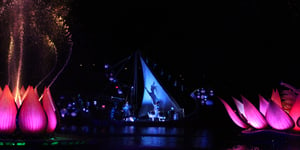
Worldwide, these and other qualities seem to be markers of the numinous: Mysterious darkness, dazzling complexity, and overwhelming luminosity. There is evidence that human cultures have been using these “pointers toward the transcendent” almost since the birth of culture itself! And in fact, I think contemporary Americans continue using these strategies for the same, intuitive purposes, in art galleries, concert halls, amusement parks, museums, and more. It’s time our postmodern culture learned to recognize the signs of the numinous in its midst. Just like our ancestors, we bear witness to something that transcends ordinary perception, inspiring awe and worship.
.jpg) Disneyland's display titled “Rivers of Light” evokes religious expressions throughout human history / CC BY 2.0 via
Disneyland's display titled “Rivers of Light” evokes religious expressions throughout human history / CC BY 2.0 via
Wikimedia Commons
For more information about humanity’s shared way of expressing the numinous, see Dr. Kresser’s new book, Church Beautiful: Sacred Art and Spiritual Healing.