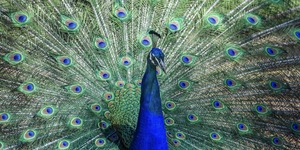
The spectacle of the peacock’s tail when spread is indeed a sight to behold.
Roman legend has it that Juno, wife of Jupiter, cast the 100 eyes of the giant Argus into the tail of the peacock to honor his memory after he was killed. In Christian art, these “eyes” symbolize the all-seeing eyes of God.
The peacock is also associated with immortality since the Greeks believed that the flesh of the peacock would not decompose.
Often startling the modern mind with their keen observations of Nature, this Greek belief in the “immortality” of peacock flesh, however, is false. Having exceptionally tough skin might slow down its decomposition, but all animal flesh decomposes with the action of bacteria and other environmental factors.
What is fantastic is the now-documented arrangement of crystals that produce the vibrant blues, greens, and even browns in the feathers of the peacock.
Colors in Nature
When we think of colors, we are often thinking of pigments. Pigments are chemicals that absorb certain wavelengths of light, while the remaining wavelengths of light are reflected to the eye. Pigments are often found in the distinguishing features among species, used to identify food sources, and for mating. As chemicals, pigments may be derived from food sources or be produced by the organism itself. Humans have been extracting and using plant and animal pigments for millennia to create beautiful fabric and paints.
Structural coloration is different. It involves the interference (reflection, transmittance, or scattering) of light by micro-scaled structures within the object or organism. So what are these structures in the feathers of a peacock?
According to this study, if you ground down the feathers of a peacock, only brown dust would remain. How is that possible given the vibrant colors that we see? The coloration strategies in peacock feathers are “very ingenious and simple”: “the blue, green, yellow, and brown barbules in the eye pattern of a male green peacock (Pavo muticus) feather” are caused by a variation in a 2 dimensional crystalline structure of the cortex of the different feathers. In other words, the color isn’t in the feathers, but is caused only when light interacts with the crystalline structures within the feather. Ingenious, yes, but simple? As one commentator observed, what we find is remarkable:
"Not a gem—a photonic crystal: a precise, repeating lattice of melanin rods stacked in orderly rows inside clear keratin, with tiny channels of air running between them. A grid. A grating. An array as regular as something etched in a chip factory—grown by a bird, in the dark, out of pigment and air."
When pondering the “simple” color production of peacock feathers, it is hard to avoid asking the question: if natural selection demands that evolved traits must contribute to an organism’s survival, why such an extravagant expenditure of energy and effort to produce not only color but startling patterns? There are quite a few examples of this extravagance in nature.
Beauty and Evolution
The bowerbird has radiantly beautiful red and orange plumage, but that seems not to be enough to attract a mate. When the male bird is ready to mate, he designs and builds a “bower,” which is an architectural work of art:
". . . an assemblage of twigs shaped into a spire, corridor or hut. They decorate their bowers with scores of colorful objects, like flowers, berries, snail shells or, if they are near an urban area, bottle caps and plastic cutlery."
The “creativity” put into the structure isn’t just about choosing vibrantly colored objects:
"Some bowerbirds even arrange the items in their collection from smallest to largest, forming a walkway that makes themselves and their trinkets all the more striking to a female—an optical illusion known as forced perspective that humans did not perfect until the 15th century."
In a startling turnabout, even some evolutionary biologists have embraced the idea that not all traits that evolve can be explained by natural selection.
Beauty, they say, does not have to be a proxy for health or advantageous genes. Sometimes beauty is the glorious but meaningless flowering of arbitrary preference. Animals simply find certain features—a blush of red, a feathered flourish—to be appealing. And that innate sense of beauty itself can become an engine of evolution, pushing animals toward aesthetic extremes. In other cases, certain environmental or physiological constraints steer an animal toward an aesthetic preference that has nothing to do with survival whatsoever.
Where could this “innate” sense of beauty come from?
Beauty and the Transcendent
In his Aesthetics, German philosopher Dietrich von Hildebrand maintains that beauty is essential to human life.
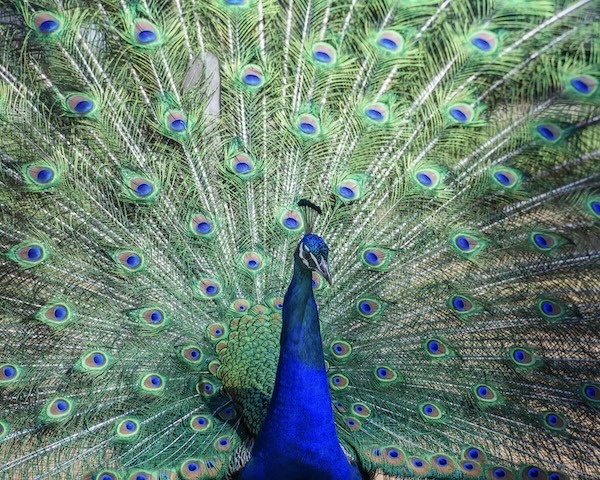 Lokrum Island Peacock by Danielle Six taken in Lokrum Island, Croatia in 2022 / DanielleSix Photography / Instagram: @danielle.six.photography / permission given by photographer.
Not only “sensible” beauty—that type of beauty communicated through the senses, but the beauty that is built into our experience of the world itself. One of the three transcendentals (truth, goodness, and beauty), this type of beauty contributes to human happiness by calling to mind the deeper reality behind the sensible perceptions. In fact, the physical, sensory aspects of a beautiful object, or landscape, or piece of music often seem insufficient to explain the depth of our experience of it. In other words, it “radiates a spiritual plenitude disproportionate to its material elements.”
So beauty has a profound effect on humans and apparently may affect even animals!
Beauty is a reminder.
Embedded in all of creation—appearing as it does in the extravagant patterns, colors, and harmonious sounds perceived by the senses—Beauty is there to remind us of Him Who first looked upon the beauty of the world and declared it good.