Skip to content
JWST Logo Mural

Critical Catholic Cosmology

Discover the strongest arguments for and against the soul, God’s existence, and the historicity of the Resurrection from scientific, philosophical, historical, & biblical perspectives.

Share on Social

Now Available Nation-Wide with Remote and In-Person Enrollment!

A Two-Semester Postgraduate Course created for Catholic Educators Who Are:

  • Interested in investigating life’s biggest questions in an environment that is academic, non-judgemental, and grounded in evidence
  • Curious about how questions of faith collide with cutting-edge scientific discovery and wonder how much of the Gospel is historically true
  • Looking for an affordable way to earn +6 postgraduate credits

Details

Location: Online and Xaverian Brothers High School, Westwood, MA

Date: Thursdays beginning Oct 1st, 2026

Time: 4:30 p.m. — 6:30 p.m. ET - 14 Classes per Semester

Cost: 

-Online and Hybrid: $475 per semester
-Fully In-Person Discount: $350 per semester

Accreditation: 6 credits through Pope St. John XXIII National Seminary (3 Credits per Semester)

Semester Content

Semester 1: The Case for God & the Human Soul (3 credits)
Semester 2: The Identity of God & The Resurrection (3 credits)

See below for more details.

Special appearances by Fr. Robert Spitzer, S.J., PhD each semester!

Email Course Instructor

Cosmology course image

NOW ENROLLING ONLINE NATIONWIDE AND IN-PERSON IN THE BOSTON AREA

Discover the strongest arguments for and against the soul, God’s existence, and the historicity of the Resurrection from scientific, philosophical, historical, & biblical perspectives.

New science is demonstrating evidence of the soul and afterlife. New mathematical proofs demonstrate that our universe and time had an absolute beginning. New biblical scholarship—even among skeptics–is revealing clues about the historical truth of the Resurrection, while forensic evidence from the scene of the crime reveals a supernatural event imprinted on the oldest, most scientifically investigated relic in human history.

Since the Enlightenment, the rapid advance of human knowledge has seemed to challenge, replace, and upend traditional religious beliefs. But as science continues to advance, we discover an astounding truth; the evidence is converging once again on the God hypothesis as the only theory with sufficient explanatory power. It’s the biggest news, but no one is talking about it.

Until now. Introducing Critical Catholic Cosmology–a new course designed to finally bring Catholic Educators to the cutting-edge intersection of science, philosophy, and faith, not only to encounter God anew but to uncover the solid ground for the faith standing right under our feet.

Semester I Focus:

THE CASE FOR GOD & THE HUMAN SOUL

(3 Credits)

Class 1: Hero's Journey, Information, Meaning & The God Concept

Class 2: The Hard Problem of Consciousness and AI

Class 3: Gödel & Animal Language: Evidence of Transphysical Consciousness

Class 4: Near Death Experience and Science of the Soul

Class 5: Eastern Religions: Hinduism, Buddhism, Daoism

Class 6: Abrahamic Religions: Judaism and Islam Part I

Class 7: Abrahamic Religions: Judaism and Islam Part II

Class 8: Atheism, Hell, and The Problem of Evil

Class 9: Theodicies 1: Greater Good, Beauty, & Journey

Class 10: Theodicies 2: Free Will & Redemptive Suffering

Class 11: Natural Evil, and God of the Gaps 1

Class 12: God of the Gaps 2: Genesis vs. Big Bang and Evolution

Class 13: The Bible and Science: Truth Can’t Contradict Truth

Class 14: Fr. Spitzer Q& A


Semester II Focus:

THE IDENTITY OF GOD & THE RESURRECTION

(3 credits)

Class 15: Philosophy 1: Aquinas, Pure Act & Existence Itself

Class 16: Philosophy 2: The Xbox Problem and Teleology

Class 17: The Beginning Universe: Borde Guth Vilenkin

Class 18: Fine Tuning and the Multiverse: The Heavens Declaring the Glory of God

Class 19: Revelation, Inspiration, and The Bible

Class 20: God & Faith: The Historical Value of Biblical Data

Class 21: God & Faith: Evidence the Bible is Inspired

Class 22: The Dating, Authorship, and Historical Reliability of the Gospels

Class 23: The Historicity of Jesus and His Miracles

Class 24:The Historicity of Resurrection Part 1: 1st Century Judaism

Class 25: The Historicity of Resurrection Part 2: The E’s of Biblical Evidence

Class 26: Forensic Evidence of the Resurrection Home, and the Final Theodicy

Class 27: Miracles, Mysticism, Visions, Angels, and Demons

Class 28: Fr. Spitzer Q& A

Course Philosophy
course philosophy


Invitation to Encounter

My parents always taught me that if I sought the Truth with a sincere heart that I would find it. This means that, devout as my Catholic upbringing was, I was always encouraged to question my faith. Then a crisis in college led me into almost a decade of jaded atheism. Rebuilding my faith brick by brick has given me a unique perspective on what it means to believe and the value of a relationship with God built on no assumptions. For me, this course is much more than a presentation of facts and ideas; it's an invitation to journey toward a new kind of encounter with God.

Theology as Discovery

Theology does not have to be a top-down imposition of stale dogmatic principles demanding conformity and obedience–nor does the mystery of God have to be a distant, abstract, or impenetrable enigma. Today, cutting-edge discovery is meeting the Word of the Living God in new and fascinating ways all the time. The more we learn, the more it is demanded of this generation to reimagine how we know what we know. We are called to structure a paradoxical epistemology, one that remains firmly anchored to the Truth and yet open enough to learn the ways that we've been wrong. Whatever our discipline, it's our job as Catholic Educators to help our students build this framework.

In Harmony, Small Things Grow

By approaching these topics together with humility, compassion, trust, and zeal, we can begin to ask ourselves what we really believe—and how we know it's true and worth believing. The work begins by fostering a crowd-sourced, bottom-up consensus. Then we apply careful scientific and philosophical methodology to investigate the most profound questions of human thought and existence. Who are we? What gives us meaning? Does God exist? How do we know? Can the Bible be trusted? This class is for truth-seekers on any walk of the faith journey, welcoming thoughtful discussion and respectful disagreement while remaining dedicated to a common objective: the Truth.
Joseph webb stained glass
 
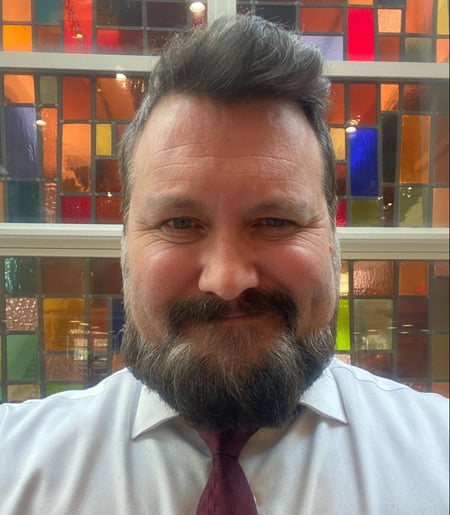
Joseph Webb, a seasoned educator, cradle-Catholic, and former atheist, brings a unique perspective to the intersection of faith, philosophy, and science. In addition to a theology degree from Fordham University, Joe holds a Master’s in Education and Instructional Design from Northeastern University, and, in concert with advanced theological studies at Boston College’s School of Theology and Ministry, Joe is pursuing his doctorate in the Philosophy of Science.
Joe has brought a commitment to scientific inquiry to bear on Catholic thought, and has offered a rigorous exploration of theology informed by the latest in cosmological and philosophical research to adult and high school students for the better part of a decade. Joe believes that a collaborative, ecumenical, and evidence-based dialogue is the best way to build a critical paradigmatic consensus. Built on this consensus foundation, he hopes to invite educators to reimagine and reencounter faith grounded in a robust and well-rounded evaluation of the interdisciplinary landscape. With an emphasis on open dialogue and thoughtful questioning, Joe has designed the Critical Catholic Cosmology program to foster a community of truth-seekers eager to understand the cosmos as a dynamic meeting place of faith and empirical inquiry.
 
Joe endeavors to emulate St. John Bosco, whose approach to teaching focused on genuine engagement, understanding, and dialogue. Inspired by Don Bosco's ethos, Joe strives to create an environment that is both intellectually rigorous and deeply relational, where students feel known, respected, and inspired to seek truth. Joe is also inspired by Don Bosco’s care for the young–and is honored to offer this course for the benefit of fellow educators who share in the responsibility to carry on the mission of Catholic Education for young people today.
Jesus of Science Banner

FAQ's

Who is this course for?

This course is designed for Catholic Educators and adults who hold a bachelor's degree in any discipline. While the course is grounded in the Catholic perspective, it welcomes atheists, agnostics, and students from any faith tradition.

Should I Enroll for the Online or In-Person Experience?

This course is hybrid; it will be hosted in-person and broadcast via zoom. Students from remote locations are able to take the course fully online, participating in synchronous class discussion. Students in the Boston area are able to choose between taking the course hybrid (at the online price point) or fully in-person (at a discounted rate). 

What is the difference between the Online and In-Person Experience?

Both experiences offer the same content, assignments, synchronous discussion, and require active participation. Both can be taken pass-fail. Fr. Spitzer will make a guest appearance each semester for all in-person and online students via Zoom. The online or hybrid experience offers the convenience of a remote course that can be attended on the go or from the comfort of your own home. Students who commit to the fully in-person experience will benefit from in-person learning and interaction, a tuition discount, access to our Spitzer Lending Library, and gourmet snacks served each class.

Where will the in-person sessions be held?  The in-person classroom is located at the Xaverian Brothers High School in Westwood, MA in the Trustee Conference Center in the Library.
When does this course begin? The first semester begins on Thursday, October 1st, 202, and consists of 14 classes that run through the beginning of January.
Where can I find the Course calendar? The finalized course calendar will be sent via email upon registration, but for planning purposes, know that classes will not meet during Thanksgiving or Christmas Break.
What time will the course be held? How long is each class? Classes will run on Thursdays, from 4:30-6:30 pm Eastern Standard Time.
What happens if I miss a class? To pass the class, students are permitted to miss no more than two classes; however remedial sessions may be provided at the end of the Semester to students who have missed requisite content.
Will the Second Semester run in the Spring? The Second Semester is slated to begin in late January/early February, and run through May. Details for the Second Semester are still being finalized. Stay tuned!
How much does it cost? Tuition for the Online and Hybrid Course is $1,275 per student per semester. Students who commit to the fully in-person experience receive a discount, and will pay $450 per student per semester.
Can I switch between the Online and in person experience? Between Semesters, students may switch from In-Person to Online and vice verse for the next Semester. Mid-Semester, students who are not hybrid may switch from in-person to hybrid, but will no longer be able to benefit from the in-person tuition discount.
What topics will be covered?

Click here for the class title listing. Click here for a copy of the syllabus.

Who will be teaching this course? The course will be taught by Joseph Webb, with special appearances by Fr. Robert Spitzer each semester
Do I need a theology degree to take this course? Participants need only have a bachelor’s degree in any discipline. No formal theology experience required.
How much reading/written work will be involved?

There will be short 8-15 min reading and viewing assignments each week, and an ongoing Capstone project. While some minimal objective assessments may be required periodically, the goal of this course is to keep work to a bare minimum for the convenience of busy educators, and to keep 90% of the work in the classroom.

How is this course accredited? The course is accredited through Pope St. John XXIII National Seminary. Click here for more information about the Seminary.
Can I take this course pass/fail? There is a pass/fail option for this course.
Can I audit this course? We are now offering an audit option of $50 per class, or $250 per semester. Students who audit the course may attend lectures in person or online and will be exempt from assignments. However, auditing students will not be added to our Google Classroom, nor will they have access to the Slide Shows or Primary Source materials. Auditing students cannot receive graduate credit. If you are interested in auditing this course, please use the form at the bottom of this page.
Is this course going to be offered in other cities besides Boston? It may be able to expand our offerings in the future. Please reach out to Joseph Webb for more information.
Gourmet Snacks? What kind? Meat, cheese, crackers, veggies, fruit, cookies, chips, water, coffee, ice tea, and seltzers are baseline staple offerings for refreshments at each class. Suggestions and special dietary requirements will be accommodated.
Question not listed here?

For any additional inquiries, please use the form below.

Remember that education is a matter of the heart, of which God is the sole master, and we will be unable to achieve anything unless God teaches us, and puts the key in our hands…”

St. John Bosco

Subscribe to CCC Insights to Receive Periodic Faith and Science Reflections and Submit Your Inquiries